This year we have a lot of excellent experience reports from a range of practitioners who've been doing exiting new things and some really outstanding keynotes.
XP Day London 09: Programme
After a lot of wrangling the almost-but-not-quite final programme for XP Day London is now available. Because of illness and other asynchronous distractions some of the presenters had to change at the last minute we still have to nail down one session, but this will be pretty much it.


Scheduling by value?
David Peterson has started a new blog on Kanban (and snaffled a very tasty URL for it). He presents this discussion of scheduling features into a development team. The case the David presents is related to a behaviour I sometimes see with inexperienced teams who's just had someone go learn Scrum. Comes the next planning meeting and this idea pops up that the backlog needs to be ordered by "business value" so that the "most valuable" features can be delivered earliest.
This can easily lead to some very nasty scenes where the Scrum Master demands that the Product Owner produce a "value" for each story—actually write a number on the card. The problem comes to a head when it turns out that the Product Owner not only doesn't know the value of the stories they are putting on the backlog, but they also have no way of finding out what they value of a story is. And this isn't because they are stupid, nor incompetent, nor malicious. It's because finding that value is far, far too difficult and time consuming an activity. And there's a good chance that any answer that came out of it would be so well hedged as to be meaningless.
Sometimes the Product Owner does know, or can find out at reasonable cost, a value for a story or feature. Being able to trade a new asset class probably can be valued. Changing a flow to give 10% high conversion probably can be valued. Improving a model to get 1% higher efficiency in the machines it's used to design can probably be valued. These valuations will be functions of time time and various other parameters. If you really have to, you could get a number of them that's valid today (and perhaps only today). David makes the point that even if you do know that number for a feature, scheduling the next one simply on the basis of highest value might not be the smartest move. There are other variables to consider.
There is a case to be made that within the context of a project value isn't the best figure of merit to use anyway, since someone should have made a go/no-go decision at some point that the planned budget and planned value seemed reasonable. That decision should be re-assessed frequently (far too little of this goes on) based on progress to date, and action taken if the actuals have come too far adrift, but in-between those times trying to optimise on value is perhaps not worth it.
Another option is to indeed demand (and obtain) those value numbers and then schedule work primarily on the basis of business value and dispense with effort estimates, so-called "naked planning". This has caused eyebrows to be raised. The underlying claim is that
value varies along an exponential scale while development costs vary along a linear scale. Therefore delivering the most valuable features trumps any consideration of whether or not the most valuable feature is cheap or easy to developwhihc, if true of your environment, might give pause for though. How this interacts with the desire to schedule so as to maximise throughput at the bottleneck is an open question, for me at least.
Service-Oriented Architecture
I'm currently embroiled in the long and fraught process of having telephony and data services installed in a certain location. One supplier steadfastly and consistently refused to respond to my offers to become a paying customer, so I selected another who were very responsive at first, but have become less and less so over time. In fact, it's about two months since I signed and still no service has been provided (although bills have been sent).
Part of my frustration with this is that it's very hard to find out what's going on. The company, a British telecoms provider and let's leave it at that, was once a monolithic monopoly but now has been dissected into multiple different business units, components, we might almost call them, each—I suppose—focussing on its so–called Core Competence (and more on that in a later post). Each of these components has its various workflows that it does and one or more contracts with other components for services it supplies or consumes and the components communicate by passing electronic messages to one another. Sometimes they pass electronic messages to me, complete with the URL of some other component where I have to go and do some action. It's all very slick and automated and orchestrated and, indeed, seems to have a mind of its own.
For instance, the putting-in-wires component received a message telling it to come to my location and do just that. Unfortunately, the agent of the no-I-mean-really-putting-in-wires component to which they delegated implementation of that action was not able to complete it. He sent a message saying so and various exception flows kicked off, requiring a lot of manual intervention, oh yes.
Meanwhile, the arrange-for-telephony component turned out to have a clock running and when a certain (unpublicised) duration had elapsed without it receiving a notification of success from the putting-in-wires component (which was busy with some recovery actions on the no-I-mean-really-putting-in-wires component) it triggered a flow that cancelled my original request to have some services. A notification was received by one (but not all) of the taking-money-off-you components and one of them sent me a message telling me that my order for some services had been cancelled. A good thing, because otherwise I would have been blissfully unaware of the situation. On the other hand I am now angrily aware of the situation.
Now, here's the fun bit: irrespective which component sends me a message, no agent working for that component can explain to me what the message means, because whatever it means that meaning belongs to whatever other component sent the earlier message that lead the the message I received being sent. And no, they can't put me through to an agent in that component. There is no interoperability layer.
Today I spoke with five agents in three different components. One of them gave me quite the run–around because although I had contacted him through the callback given in the message I'd received from his component I had mis–configured part of my message header leading to my message being dispatched to the wrong agent because I had misunderstood the published specification for that header which he freely admitted was itself a shoddy piece of work with unreasonable and misleading contents but it was still my problem that I'd botched the message send.
Also, I've learned that to get to speak to an agent at all I have to go twice around the loop of failing a handshake because I can't provide a piece of data that the protocol requires but that I won't get until the request succeeds. After two failures in a row a supervisory process notices and I'm failed over to a more generic service through which I can contact an agent, but that service is not exposed on a public URL.
To all of which I say: bring back the mainframe.
Observations on Estimation
Teams following a process like Scrum tend to estimate the "size" of stories as an aid to figuring out a commitment for a sprint. My view is that this is a transitional practice, and that the aim should be to learn how to make stories all roughly the same size so that commitments (also a transitional practice) can be determined by counting.
While all of that is going on teams that want to use a numerical scale to estimate (rather than, say, "t-shirt" sizing) tend to choose a scale, a sequence of licit values from which estimates must be drawn. The various planning tools that demand a numerical field be filled in tend to force this issue.
I've noticed a tendency for "expert" level practitioners to want to use some clever non-linear scale, maybe Fibonacci numbers (1,2,3,5,8,13), maybe a geometric series (1,2,4,8,16) and they will have some sophisticated reason why this or that series is preferred. And I've noticed that a lot of teams aren't comfortable with this. They want to use a linear scale.
It seems to be traumatic enough that the estimates don't have units, or even dimensions. The idea that estimates are dimensionless but also structured can be a double cause of confusion.
Anecdote: a team had been estimating and planning and delivering consistently for a good long time. Their velocity was fairly constant, but drifted over time (fair enough). One day it turned out that their velocity happened to be numerically equal to the number of team members times the number of days to the next planning horizon. Someone noticed this and with a huge sigh of relief the team concluded that these mysterious "units" in which they estimated were actually man-days in disguise. Now they finally understood what they were estimating! And they promptly lost the ability to estimate: their next planning session was all over the place and it took some time for their planning activities to converge again. My inference was that it's actually quite important that estimates are dimensionless.
Anecdote: a User Experience expert at a client had been involved in some research whereby (as a side effect) members of the general public had to create a scale that made sense to them within which to rank the usability of features. These folks were presented with different generic objects and asked to give them a "size", and then to give a corresponding "size" to some other generic objects in order to create a scale that made sense to them, which would then be applied to the merit of the system features that were the actual target of the research. They created linear scales.
While all of that is going on teams that want to use a numerical scale to estimate (rather than, say, "t-shirt" sizing) tend to choose a scale, a sequence of licit values from which estimates must be drawn. The various planning tools that demand a numerical field be filled in tend to force this issue.
I've noticed a tendency for "expert" level practitioners to want to use some clever non-linear scale, maybe Fibonacci numbers (1,2,3,5,8,13), maybe a geometric series (1,2,4,8,16) and they will have some sophisticated reason why this or that series is preferred. And I've noticed that a lot of teams aren't comfortable with this. They want to use a linear scale.
It seems to be traumatic enough that the estimates don't have units, or even dimensions. The idea that estimates are dimensionless but also structured can be a double cause of confusion.
Anecdote: a team had been estimating and planning and delivering consistently for a good long time. Their velocity was fairly constant, but drifted over time (fair enough). One day it turned out that their velocity happened to be numerically equal to the number of team members times the number of days to the next planning horizon. Someone noticed this and with a huge sigh of relief the team concluded that these mysterious "units" in which they estimated were actually man-days in disguise. Now they finally understood what they were estimating! And they promptly lost the ability to estimate: their next planning session was all over the place and it took some time for their planning activities to converge again. My inference was that it's actually quite important that estimates are dimensionless.
Anecdote: a User Experience expert at a client had been involved in some research whereby (as a side effect) members of the general public had to create a scale that made sense to them within which to rank the usability of features. These folks were presented with different generic objects and asked to give them a "size", and then to give a corresponding "size" to some other generic objects in order to create a scale that made sense to them, which would then be applied to the merit of the system features that were the actual target of the research. They created linear scales.
[After seeing this he added the observation that this process was in aid of avoiding what often happens with the strongly disagree, disagree, no preference... type of scale which is either polarised or bland results, neither of which is that useful]
That surprised me at first, since I know that the physics of our sensory apparatus are generally non-linear, and memory is non-linear and so forth. But thinking about it some more I realised that our experience tends to seem to be linear, even if the underlying phenomena aren't.
Meanwhile, if one did want to use a particular scale for estimating the size of stories, why not use one of the series of prefered values? They are very well established in engineering and product design and offer interesting error-minimising properties. On the other hand, it might be a real struggle to get a team to decide if a story was a 1.6 or a 3.15
I don't have a grand narrative into wich to fit these observations, but here is another related anecdote about estimation.
That surprised me at first, since I know that the physics of our sensory apparatus are generally non-linear, and memory is non-linear and so forth. But thinking about it some more I realised that our experience tends to seem to be linear, even if the underlying phenomena aren't.
Meanwhile, if one did want to use a particular scale for estimating the size of stories, why not use one of the series of prefered values? They are very well established in engineering and product design and offer interesting error-minimising properties. On the other hand, it might be a real struggle to get a team to decide if a story was a 1.6 or a 3.15
I don't have a grand narrative into wich to fit these observations, but here is another related anecdote about estimation.
Real Engineers
There's a recurring fashion for beating up those who would build software for a living with tales of how "real" engineers do it. This started with the woefully misguided "Software Engineering" conferences of the late 1960's and continues on-and-off to this day.
As a response to this I like to collect examples of "real" engineers screwing up. Not out of malice, but out of a desire to ground certain aspects of my professional life in something resembling fact. Here are some reported facts about the Lockheed Martin F-22 "Raptor" fighter aircraft:
As a response to this I like to collect examples of "real" engineers screwing up. Not out of malice, but out of a desire to ground certain aspects of my professional life in something resembling fact. Here are some reported facts about the Lockheed Martin F-22 "Raptor" fighter aircraft:
- the aircraft has recently required more than 30 hours of maintenance for every hour in the skies
- the canopy needs refurbishing after 331 hours of flying, less than half the design goal of 800 hours, and this costs $120,000 a pop
- the aircraft is almost twenty thousand dollars more expensive to fly per hour than its predecessor (which costs an already eye-watering 30+ grand per hour—what do they run on, Chanel No 5? Single malt whisky?)
Change
We aim to keep all our offices ISO 9000 certified. This means updating the procedures to reflect our increasing tendency to run software development projects under an Agile process. It's fallen to me to update our existing "Change Control" procedure which of its kind is very good, but does build up from the assumption that to have a change to control is an exceptional (although expected) event.
I keep wanting to turn that inside out and say—deal with every requirement this way, make this the default, make the threshold of cost/schedule/risk impact for triggering change control be 0.0 in all cases, have the Change Control Board meet every week, have them assess the impact of every item and decide whether or not to schedule it, have no other way to schedule any activity than via the change log. And bingo! Your project would pretty much be agile.
In fact, I might just do that.
De–skilling through Technology: friend and foe
Once, and for a mercifully short time, I lived on the very western edge of Bournemouth. You might recall that Ford considered his article for the Guide describing how to have a good time in Bournemouth to be one of his finest pieces of fiction. So, I was often wanting to go away, farther away than I could sensibly go on my pseudo-vintage motorcycle in what time was available. That meant going from the County Gates to Bournemouth railway station. This could be done on the cramped, slow local bus or at great expense by taxi.
But I noticed that the long–distance coaches coming in from the even further south and west of England made one last stop before Bournemouth Coach Station (adjacent to the railway station) in Westbourne, just around the corner from me. These coaches are large, have luggage space and go fast on major roads. And the on–line booking system did not blink an electronic eye at me buying and downloading to print out a 90 pence ticket to ride from Westbourne to Bournemouth. The drivers of the coaches did blink when I got on there, but I had a ticket so they shrugged and went about their business. That's nice. Imagine the counter–arguments that would likely come from a human ticket agent who knows only too well the various alternatives to doing so preposterous a thing as riding a long–haul coach half–way across the town where you live.
Now, much more recently I was on the very edge of the very agreeable city of Charlotte, North Carolina. I had been down–town to check out the excellent Mint Museum. Being a citizen of the Socialist People's Republic of Europe I naturally tried to do the journey by public transport. Charlotte has a pretty good public transport system, C.A.T.S. However, it turned out that the bus service that would otherwise run from exactly the last stop of the light rail system (the "Lynx") to exactly my hotel was not running that day. Nice try, but I have to do the last few miles by cab. Now, I am a stranger to the city and am in any case in a fairly obscure part of it. I call a cab company and while I can explain with a certain degree of accuracy where I want to go, I don't know where I am.
And that's a problem.
The cabs are guided by GPS, so they need an exact street address for pickup and set down. This is so that the drivers do not need to know their way around. That's a pretty shocking concept for a resident of London, where cab drivers know their way around so well it changes their brains. Troublesome de–skill #1.
All I know is that I'm at the last stop of the Blue Line, but I don't know where that is. And neither does the dispatcher at the cab company—after all, all they do is pass on the co–ordinates of two places they don't know the location of to drivers who don't know the route between them. De–skill #2. Luckily for me, the dispatcher thought that they knew someone who might be able to figure out where this Lynx station was. I should call back in a few minutes. I do so, and by virtue of the elevated situation of the station I can call off enough landmarks (that is, names of shopping malls) for this person at the other end to work out where I am. My hotel, for some reason, they can look up very easily.
Some time later a cab rolls up. And it turns out that all this marvellous de–skilling has been wasted because the guy is a veteran driver and knows the district like the back of his hand.
Also, once I'm seated and strapped in, his first question is: so, where are we going?
Finish-start Dependencies: just say no!
 I'm working with a team that have (as do we all) a tendency when under stress to fall back upon what they are comfortable with—in particular, to serialising their activities. "We can't x because they haven't finished y because they're waiting for z..."
To help them remember that this isn't the best move they can make, I've devised this symbol to display in the team area. You are welcome to use it yourself.

No Serialised Activities by Keith Braithwaite is licensed under a Creative Commons Attribution-Noncommercial-Share Alike 2.0 UK: England & Wales License.
Based on a work at 1.bp.blogspot.com.
Learning from Architects
From dog–houses to skyscrapers, the discipline of the building architect has long been a rich source of metaphor for system architects. I don't disagree, indeed in one of my contributions to the 97 Things Every Software Architect Should Know I recommended that software architects should learn from architects of buildings. So, you can imagine that my eye was caught by Matthew Frederick's 101 Things I Learned in Architecture School. This small book contains the eponymous count of hints, tips and tricks from a qualified architect to architecture students.
This is a good resource for those of us who would learn from architects of buildings, as it is advice to would–practitioners from a practitioner and as such relates to what building architects actually do, rather than what someone who isn't a practitioner thinks they must, surely, do. This latter is a common failure mode of software professionals seeking inspiration from other disciplines—all the way back to the very first Software Engineering conferences of the late 1960's, in which an hallucinatory notion of what "engineers" do was foisted upon us. But I digress.
Some of the 101 are very low level and very specific (eg Number 90 "Roll your drawings for transport or storage with the image side facing out"), others are much broader and seem to me to have relevance for any sort of design work.
Number 15 tells us that "A parti is the central idea or concept of a building." Wikipedia tells us that parti is from the French prendre parti "to make a decision". The parti captures, presents and summarises the highest level decision that has been made about the organising principle of an entire building or building project, and examples are given where the parti expresses all that in one, highly abstract, diagram.
A parti sounds to me a lot like a system metaphor.
Number 100 tells us that the parti should have a name, such as "half–eaten donut" or "meeting of strangers". Could the nominal (or de facto [*]) architect of the system that you are working on draw such a diagram? Would it tell anyone anything if they did? Could they name the parti, the very highest level design decision from which the rest of the system design flows?
Number 28 tells us that a good designer isn't afraid to throw away a good idea. Notice: a good idea. An idea can be good and not fit with the parti, in which case it has no place in the design. We are advised to "save [...] good but ill–fitting ideas for another time and project—and with the knowledge that they might not work then, either." When was the last time you (or your team) threw out a good idea?
Number 46 tells us to "Create architectural richness through informed simplicity or an interaction of simples rather than through unnecessarily busy agglomerations". Frederick warns particularly against "busying up a project with doodads because it is boring without them; agglomerating many unrelated elements without concern for their unity because they are interesting in themselves." What interesting doodads does your current project have?
One reason to follow the guidance of Number 46 is given in Number 51, which observes that "Beauty is due more to the harmonious relationships among the elements of a composition than to the elements themselves". One achieves this beauty through a design process, or system.
Number 77 cautions that "No design system is or should be perfect. Designers are often hampered by a well–intentioned by erroneous belief that a good design solution is perfectly systematic [...] but nonconforming oddities can be enriching, humanising aspects of your project." 77 also observes that "exceptions to the rule are often more interesting that the rules themselves."
Number 81 notes that "Properly gaining control of the design process tends to feel like one is losing control of the design process" 81 advises that the designer should "accept uncertainty. Recognise as normal the feeling of lostness that attends to much of the process. Don't seek to relieve your anxiety by marrying yourself prematurely to a design solution; design divorces are never pretty" No, they never are.
Number 99 can help. It says "Just do something. [...] don't wait for clarity to arrive before beginning to draw. Drawing is not simply a way of depicting a design solution; it is itself a way of learning about the problem you are trying to solve." I think that much the same can be said for coding. Are the design procedures in your team aligned with these principles?
[*] Even the most self–organised, most cross–functional, most Agile, most collectively–code–owning software development team will have one individual who knows most about (and likely has most influence over) the architecture of the system. You can pretend otherwise, or you can take advantage of it.
Plaudit
Apparently, this is the 141st most "top" blog for developers (as of Q2 2009). That's probably pretty far out along some long tail of topness. Ah well.
The metric used captures something like degree of interest of the rest of the blogosphere. So, thanks for your interest.
Let's talk about feelings
I seem to recall that back in the days when he was prone to wild outbursts of public self-examination (this even before blogging and twitter) John Cleese gave an interview in part about his early experiences with therapy, with a "talking" cure. His therapist would begin, "How do you feel?" and John would say "Well, I think..." and his therapist would interrupt "No. How do you feel?" and John would say "Well, I think..." and his therapist would interrupt "No. How do you feel?" And so on. You can see the problem. And he couldn't, I suppose. Which was the problem.
More and more these days I want to ask people how they feel about their code. Here's part of why.
Ivan Moore and "the other" Mike Hill have this conference session that they do called Programming in the Small [pdf]. I love it. They put little examples of code in front of folks and invite them to refactor, just a little bit. And then reflect on the refactoring. One of the things they've noticed that programers tend to do under these conditions is futz around with the code before getting down to actually improving the design.
More and more these days I want to ask people how they feel about their code. Here's part of why.
Ivan Moore and "the other" Mike Hill have this conference session that they do called Programming in the Small [pdf]. I love it. They put little examples of code in front of folks and invite them to refactor, just a little bit. And then reflect on the refactoring. One of the things they've noticed that programers tend to do under these conditions is futz around with the code before getting down to actually improving the design.
Mike and Steve Freeman do a similar session called "Programming without Getters" This is in the so-called "dojo" format, where a revolving pair of programmers is invited to take some fairly typical "enterprise" class code and refactor it to remove the getters. There are those of us that believe that there can be something quite special about OO code with that property, but the session didn't really get there. That's because the pairs couldn't bring themselves to do the refactoring as asked, they couldn't even start to remove any getters, until they'd futzed around with the code first. And since a new person rolls into the pair every five minutes or so, it's pretty much a non-stop futz-fest.
Linda Rising saw a talk I give about this design metric that I've been playing with over the last couple of years (I have a day job, so progress has been slow). She was struck by my observation that folks who've tried this metric on their own code have reported that refactoring which made them happier with the code also increases the value of the metric. Linda wanted to know if they really said "happier". They really do.
It turns out that Linda did some research back in the day on a design metric of her own. During this work she had noticed that in general, programers like to futz around with code before they get down to work on it. If I recall correctly, she asked Dick Gabriel about this and he said that "programmers do that", along with some allusion to that metaphorical aphorism about the flavour of soup and pissing in it. I'm sure a lot of that goes on. But what Linda (again, this is as well as I recall) further noticed was that they tended to do this much less with code that scored well on her metric. And they described themselves as being more comfortable working on this code than on code that had a low score.
Now, I've nothing against metrics in principle (after all, I seem to be in the middle of inventing one) but I'm rather dubious about all this dashbordery and piechartism that's going on these days, all this getting of the CI server to dish up trends of metrics and blah, blah, blah. It's nice to have the numbers, it's nice to see a healthy trend, but.......
How do you feel about your code? Does it make you happy? Is it comfortable?
XP Day London 09: Call for Sessions
Submissions are now open for programmed sessions at XpDay London 2009, to be held 7th and 8th December 2009. http://www.xpday.org/
You are invited to propose a session for the first day of the conference. We are particularly interested in the following
To submit a session, please go to http://xpday-london.editme.com/XpDay2009Submissions
Submissions will be accepted until Friday 14th August.
You are invited to propose a session for the first day of the conference. We are particularly interested in the following
- Experience reports—share your stories of challenge and success with Agile and Lean techniques. Experience reports will be intensively shepherded by experienced practitioners.
- Hands-on technical sessions—share techniques and practices in practical sessions: workshops, tutorials, simulations
- Practitioners' advances in the art—share the techniques of expert Agile and Lean practitioners, work with them to move the craft forward.
To submit a session, please go to http://xpday-london.editme.com/XpDay2009Submissions
Submissions will be accepted until Friday 14th August.
Flow: are two dimensions enough?
Inspired by a comment by Joseph at the recent Agile Coach's Gathering I've been experimenting with the use of this model in mid-year reviews for my team.

One of the guys observed that it seems to have a missing dimension. It seems that it's possible to have a case whereby an individual is working on a solidly challenging problem, well up the y-axis, and they have the high level of skill to meet that challenge, well along the x-axis...and when all's said and done they'd really rather be doing something a bit more enjoyable.
Missing axis: fun.
Bridging the Communication Gap
Call it automated acceptance testing, functional test driven development, checked examples or what you will—the use of automatic validation is one of the most effective tools in the Agile developer's kit.
This book is a much-needed checkpoint in the on-going adventure to discover (and re-discover) how to write software effectively. Gojko is a very energetic enthusiast for these ideas, and a very experienced practitioner of them. His knowledge and expertise is present on every page.
A strong theme runs through the book—that the reason we capture examples of required behaviour and automate validation of them is to improve communication. Examples turn out to be a very powerful way to understand a problem domain and to explore a solution suitable for that domain. There turn out to be fascinating reasons for why this is true, but Gojko quite reasonably focusses on practical advice.
The main body of the book tells a story, a story of understanding, finding, and using examples to create shared understanding across a team. Gojko gives very concrete advice in a series of short chapters and explains how to do this. How to organise a workshop to find examples, how to find good examples, how to use tools to automate validation, how to use the resulting tests to guide development. Each chapter ends with a handy bullet list of key points. Together with other material on the best use for developers to make of such checked examples, and how to fit example discovery and capture into a typical Agile development process Bridging the Communication Gap provides as close to a vade mecum for newcomers to the discipline of functional test driven development as we are likely to see.
Gojko draws informative parallels with other techniques more or less strongly aligned with the Agile development world. This places the practice of Agile acceptance testing in context, and as a team-wide activity, reinforcing the cross-functional nature of the tool. Always the emphasis is on helping the various stakeholders in a development project communicate better.
There is a survey of tools available for this kind of work, which I might wish were slightly broader in scope and a little more detailed, but it does give a good overview of the market leaders. "Market leaders" in the weakest sense, since it turns out that the best tools for this kind of work are all FOSS: big-ticket corporate testing tools really aren't in this game.
Various points regarding writing and using tests are illustrated with (of course) illuminating examples. Also described are limitations of these techniques and some pitfalls to watch out for, something that more promoters of development techniques should provide.
The book is self-published and my copy was printed by Lightening Source. Books produced this way are getting better all the time, but are still not presented at the level of quality one would expect from a commercial publishing house. The pages seem very full and with the choice of font made the text a very dark colour which I don't find easy to read. The section and sub-section headings are sometimes over long and are not laid out well, a combination that I found made the book less easy to navigate than it might have been.
I will be using with book with clients and recommending it to them for future reference. A boon to the community.
The Quality of non-declining Velocity
I'm supposing that anyone reading this blog will be familiar with the stuff-left-to-do vs time chart used by many Agile teams to track the progress and (with due care an attention) predict the outcome of a development episode: In his Zurich Lean/Scrum/Agile show keynote Ken Schwaber presented an interesting slant on this chart (apparently he got this from Ron Jeffries). The argument is that if you have poor internal quality—in particular if your "definition of done" is not strong enough and does not require you to keep your code in tip-top condition—then there will be a hidden accumulation of stuff-left-to-do. So your chart is in effect more like this:
 If the causes of poor internal quality are not rectified, then this effect will repeat, and over successive episodes the team in question will get slower and slower (or deliver less and less)
 Talking about this with Karl Scotland and Joseph Pelrine in the bar afterwards we tossed around the idea that this shows internal quality (traditionally a hard thing to measure) to be something like the first derivative of project velocity with respect to time.

 In his Zurich Lean/Scrum/Agile show keynote Ken Schwaber presented an interesting slant on this chart (apparently he got this from Ron Jeffries). The argument is that if you have poor internal quality—in particular if your "definition of done" is not strong enough and does not require you to keep your code in tip-top condition—then there will be a hidden accumulation of stuff-left-to-do. So your chart is in effect more like this:
This is interestingly different from the technique that some use to show scope added during an episode, with a stepped baseline. Here, additional work is accumulating, invisibly, inside your code. Work that you will have to do at some point to get a releasable increment. This has the effect of making a burn-down line more shallow than it appears, suggesting that there will be either unanticipated under-delivery of scope or (worse yet) a need to slip delivery.
 If the causes of poor internal quality are not rectified, then this effect will repeat, and over successive episodes the team in question will get slower and slower (or deliver less and less)
 Talking about this with Karl Scotland and Joseph Pelrine in the bar afterwards we tossed around the idea that this shows internal quality (traditionally a hard thing to measure) to be something like the first derivative of project velocity with respect to time.
 And now to stretch the metaphor to breaking point. For that to make sense quantitatively it seems as if what we're really saying is that if the internal quality Q is less than some threshold Qcv (the quality of non-decreasing velocity) then the velocity V will decrease over time:
∂V/∂t∝ Q-Qcv
Well, it seems reasonable that this will hold for low quality, when Q - Qcv is negative. But what about when Q - Qcv is positive? Is it possible to take a team that is writing code at the level of quality required for non-decreasing velocity—that is, not accumulating hidden extra work—and then increase velocity by increasing quality?I think it is.
I think that a team can push really hard on internal quality and have it turn out that there is less work to do than they thought to get finished.
And maybe that's obvious—and maybe it isn't—but certainly I now feel as if I have a much better handle on how to explain to someone why (as the Software Craftsmanship folks say) the only way to go fast is to go well.
The Vendor/Client Relationship in Real Life
What would happen[youtube] if clients tried to deploy the kinds of arguments they use with "professional services" suppliers in other situations...
Epic user interface fail of Homeric proportions
A little while ago I was riding the now sadly degenerate East Coast Main Line service in a Mk IV coach and noticed a bit of a curfuffle in the vestibule (I love it that British railway carriages are still referred to as having "vestibules"). Paying attention I discovered that an elderly lady had required assistance from the train staff with the door of the toilet. This seemed a little odd, so after a suitably discreet interval I went to investigate. One has to make one's own enertainment on the train.
What I found was a flabbergasting cascade of fail.
This advice is welcome:

Judging by the design and finish, this is the original signage.
But how to close and lock the door?
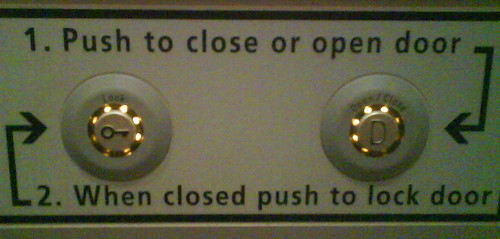
Ok, slightly non-obvious. Also, lacking some rather crucial information, it will turn out.
Seems as if more people than the lady I saw have had problems with the door, since there was this later, auxiliary sign:

Apologies for the poor quality. The text at the bottom reads "If the 'lock' button is not illuminated, the toilet doot is NOT locked" It might very well be closed, you see, but not locked. The original signage has braille attached, not so this vital little nugget of information (as I recall).
It seems that not even this prompt has quite been doing the job, as this third sign had also been added:
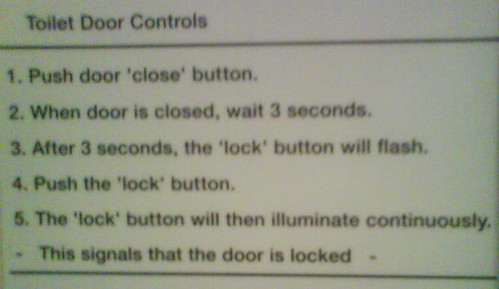
The visually impared (and those on urgent business) are now in serious trouble.
Being of an equiring mind, and finding the complexity of this control system too hard to believe, I did a few experiments and made an important discovery not covered by any of the above instructions but of no little importance I think.
If you press, or, let us say, accidentally nudge, the 'lock' button while the door is closed and locked the door (which is powered in the interest of the mobility impared, a good thing in itself) both unlocks and opens.
Now, how hard could this be? What am I missing from this design?
Still two buttons, their respective behaviour being:
What I found was a flabbergasting cascade of fail.
This advice is welcome:
Judging by the design and finish, this is the original signage.
But how to close and lock the door?
Ok, slightly non-obvious. Also, lacking some rather crucial information, it will turn out.
Seems as if more people than the lady I saw have had problems with the door, since there was this later, auxiliary sign:
Apologies for the poor quality. The text at the bottom reads "If the 'lock' button is not illuminated, the toilet doot is NOT locked" It might very well be closed, you see, but not locked. The original signage has braille attached, not so this vital little nugget of information (as I recall).
It seems that not even this prompt has quite been doing the job, as this third sign had also been added:
The visually impared (and those on urgent business) are now in serious trouble.
Being of an equiring mind, and finding the complexity of this control system too hard to believe, I did a few experiments and made an important discovery not covered by any of the above instructions but of no little importance I think.
If you press, or, let us say, accidentally nudge, the 'lock' button while the door is closed and locked the door (which is powered in the interest of the mobility impared, a good thing in itself) both unlocks and opens.
Now, how hard could this be? What am I missing from this design?
Still two buttons, their respective behaviour being:
- If the door is open, close and lock it. If the door is closed and locked, no action.
- If the door is closed and locked, open it. If the door is open, no action.
I'll be popping over to Switzerland in a couple of weeks, a place where they still take trains (and much else) seriously. And shall on the trip from Flughafen Zurich to the Haputbahnhof be paying close attention to the toilet doors.
Second Opinions
Got an opinion piece up in E&T magazine regarding second opinions.
Many thanks to all who responded to my earlier posts and enquiries about that. I'll be posting digests of some stories soon.
Many thanks to all who responded to my earlier posts and enquiries about that. I'll be posting digests of some stories soon.
Identity as a Process
Returning to a topic I've thought about before: identity is a problem.
I expect that most of you to be familiar with the "my grandfather's axe/boat/knife..." problem. In short, how does the identity of a composite object vary (or not) as the identities of the components vary? One proposed solution is the so–called perdurantist approach which hinges on the observation (at once both banal and deeply challenging) that what we think of as objects in the world are really structures with extent in three spacial and one temporal dimension (pace Kaluza-Klein type arguments). We don't seem to be very good at that sort of thinking. Note that perdurantism seems still to be talking about fixing the boundaries of a thing in order to identify it. I think that's missing a trick.
This [pdf] (via Michael Feathers) is a treatment of that trick I've not seen before.
In that paper the biological concept of autpoiesis (and the complex of ideas around it) is used to analyse the working of the glider pattern in Conway's Game of Life. I read the paper as telling us that identity of a glider is extent of the continuation of the process which at any given time looks to us like a glider.
Now, how to apply this understanding elsewhere...
QCon Panel: A Great Leap Forward or Exposed Artery?
A QCon panel disucssion re "Transparency" is now up. It features Kent Beck, Chris Matts, John Nolan and myself, with Steve Freeman in the chair.
The Treppenwitz was pretty strong on this one. What I'm thinking now is that instead of all that ghastly droning on I did, I should have said "the truth shall make you free" . The only thing to watch out for is that being free, although far superior to the alternative, might not be particularly comfortable.
But it is still far superior.
The Treppenwitz was pretty strong on this one. What I'm thinking now is that instead of all that ghastly droning on I did, I should have said "the truth shall make you free" . The only thing to watch out for is that being free, although far superior to the alternative, might not be particularly comfortable.
But it is still far superior.
Subscribe to:
Posts (Atom)